
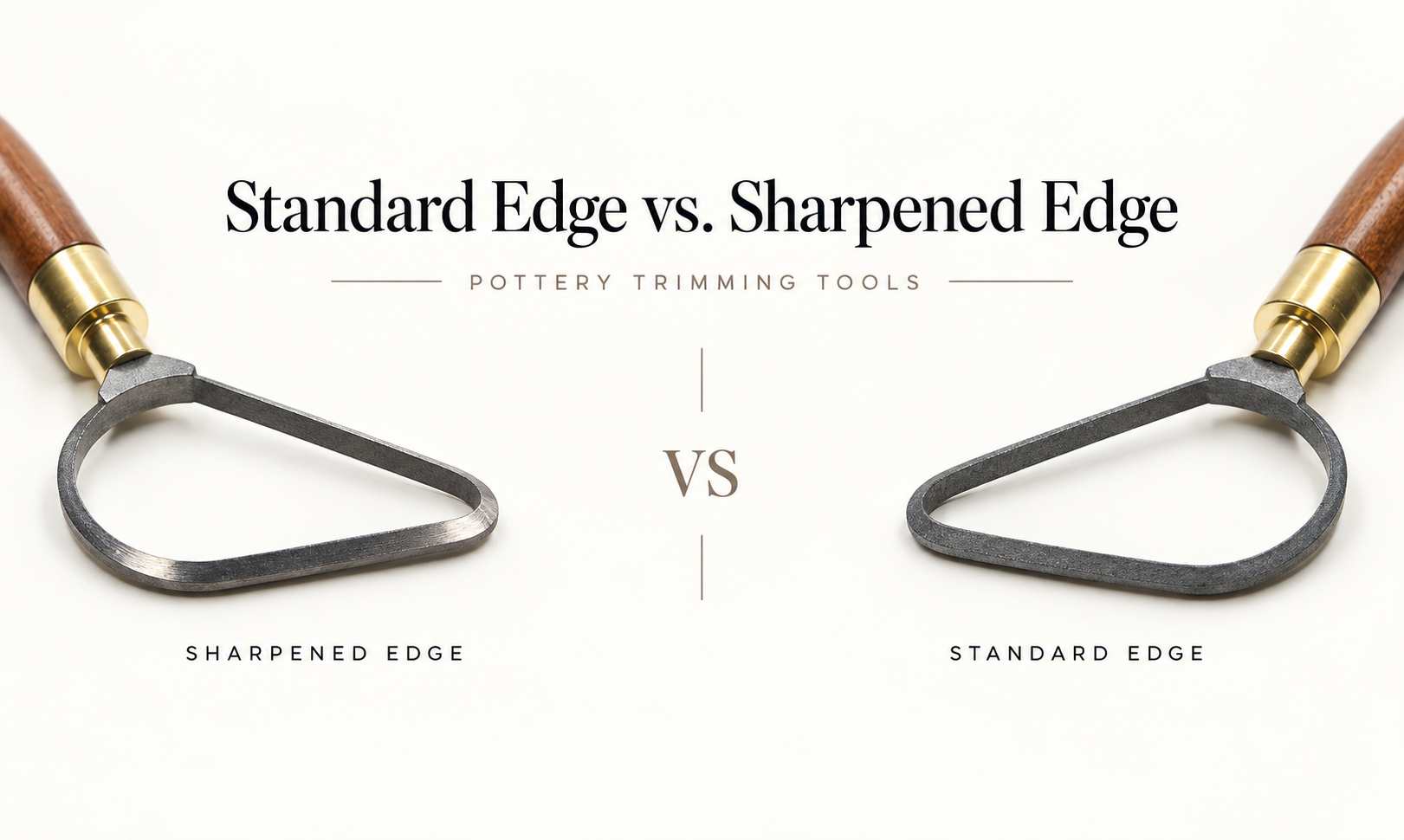
When choosing a carbide pottery trimming tool, shape is only part of the decision. The cutting edge also changes how the tool feels against the clay.
At KOVO Tools, selected trimming tools are available with two edge options:
Standard Edge and Sharpened Edge.
Both use tungsten carbide and are made for pottery trimming. The difference is not that one is “good” and the other is “better.” They provide different cutting responses and suit different trimming preferences.
What Is a Standard Edge?
A Standard Edge is the regular working edge used on our carbide trimming tools.
It is not an unfinished or blunt edge. It is made for normal pottery trimming and offers a controlled cutting feel for everyday clay removal, shaping, foot rings, and general studio work.
For many potters, this is the most practical option because it works well across a wide range of regular trimming tasks.
A Standard Edge is a good choice if you:
- Do general everyday trimming
- Remove moderate amounts of clay
- Work mainly at a normal leather-hard stage
- Prefer a controlled, slightly more forgiving cutting feel
- Want one tool for a broad range of studio work
What Is a Sharpened Edge?
Our Sharpened Edge receives an additional precision grinding process using five-axis machining.
This creates a finer, more defined cutting edge that enters the clay more readily and requires less pressure for precise cuts.
Ceramic Arts Network also notes that a clean, sharp trimming edge helps the tool cut the clay more cleanly rather than tearing the surface, while improving trimming efficiency and finish quality.
The biggest difference is cutting response.
With a sharpened edge, the tool feels more immediate. Small changes in pressure and angle are transferred more directly to the clay, making it useful when you want greater precision around foot rings, edges, transitions, and finishing areas.
A Sharpened Edge is a good choice if you:
- Prefer a sharper, more responsive cutting feel
- Do precise foot-ring or edge work
- Want to remove thin layers of clay with light pressure
- Regularly refine defined curves and transitions
- Already have good control over trimming pressure and tool angle
Standard Edge vs. Sharpened Edge
| Standard Edge | Sharpened Edge | |
|---|---|---|
| Cutting feel | Controlled and more forgiving | Sharper and more direct |
| Clay removal | Everyday and general trimming | Light, precise trimming |
| Pressure required | Normal controlled pressure | Less pressure for fine cuts |
| Best suited for | Shaping, general removal, regular trimming | Foot rings, edges, transitions, precision work |
| Clay stage | Typical leather-hard clay | Leather-hard to firmer leather-hard clay |
| User preference | Versatile everyday use | More responsive cutting control |
Neither option replaces good trimming technique. Clay condition, cutting depth, tool angle, and hand stability still affect the result.
Does a Sharpened Edge Mean It Is Better?
Not necessarily.
A sharper edge can cut more easily, but that does not mean every trimming job needs the sharpest possible edge.
For broader clay removal and routine studio work, a Standard Edge may give you all the control you need.
For smaller cuts and areas where the final line matters more, the Sharpened Edge can make it easier to work with lighter pressure and greater precision.
Think of the choice as:
Standard Edge = versatile everyday trimming
Sharpened Edge = more precise, responsive trimming
The best option depends on how you work rather than simply choosing the sharper version.
What Clay Condition Works Best?
Both edge types work best when the clay is at a suitable leather-hard stage.
If clay is too wet, even a sharp trimming tool may grab, smear, or deform the form.
If clay becomes excessively dry, cutting resistance increases and the tool may chatter or require unnecessary pressure.
A sharpened edge can be especially useful on firmer leather-hard clay, where its finer cutting geometry helps the edge enter the surface with less force.
But it should not be treated as a solution for trimming completely dry clay.
Good clay timing still matters more than edge type.
What About Stoneware, Porcelain and Grogged Clay?
Both Standard and Sharpened carbide edges can be used with common pottery clay bodies, including stoneware, porcelain, and grogged clay.
Tungsten carbide provides strong wear resistance, which is especially useful when working repeatedly with abrasive clay bodies.
The choice between the two edge types is therefore less about the name of the clay body and more about the surface condition, the type of cut, and the amount of control you want.
For broad shaping on grogged stoneware, for example, you may still prefer a Standard Edge.
For refining a clean foot or transition on the same piece, you may prefer the feel of a Sharpened Edge.
Which KOVO Tools Are Available with a Sharpened Edge?
KOVO Tools currently offers a Sharpened Edge option on three main trimming shapes:
7 Shape Hook Carbide Pottery Trimming Tool
The 7 Shape provides a focused contact point for foot rings, edges, clay removal, and controlled shaping.
Choose the Sharpened Edge version when you want a more direct cutting response around defined trimming areas.
Pear Shape Loop Carbide Pottery Trimming Tool
The Pear Loop is a versatile shape for bowls, mugs, rounded surfaces, smooth transitions, and general clay removal.
The Standard Edge works well as an everyday main trimming tool, while the Sharpened Edge gives the same familiar shape a finer cutting response.
Triangle Shape Carbide Loop Trimming Tool
The Triangle Loop works well on structured forms, flatter trimming areas, edges, transitions, and defined shaping.
Its Sharpened Edge option is useful when cleaner lines and controlled finishing passes are a priority.
Which Edge Should You Choose?
If you are unsure, start with the way you normally trim.
Choose Standard Edge if most of your work involves regular clay removal, shaping, and everyday trimming and you want a versatile cutting feel.
Choose Sharpened Edge if you regularly work on precise foot rings, clean edges, controlled transitions, or light finishing cuts and prefer the tool to respond with less pressure.
Some potters may also prefer to use both: a Standard Edge for the main trimming work and a Sharpened Edge where greater precision is useful.
There is no universal “better” edge.
The right choice is the one that matches your clay condition, the area you are trimming, and the cutting feel you prefer.