
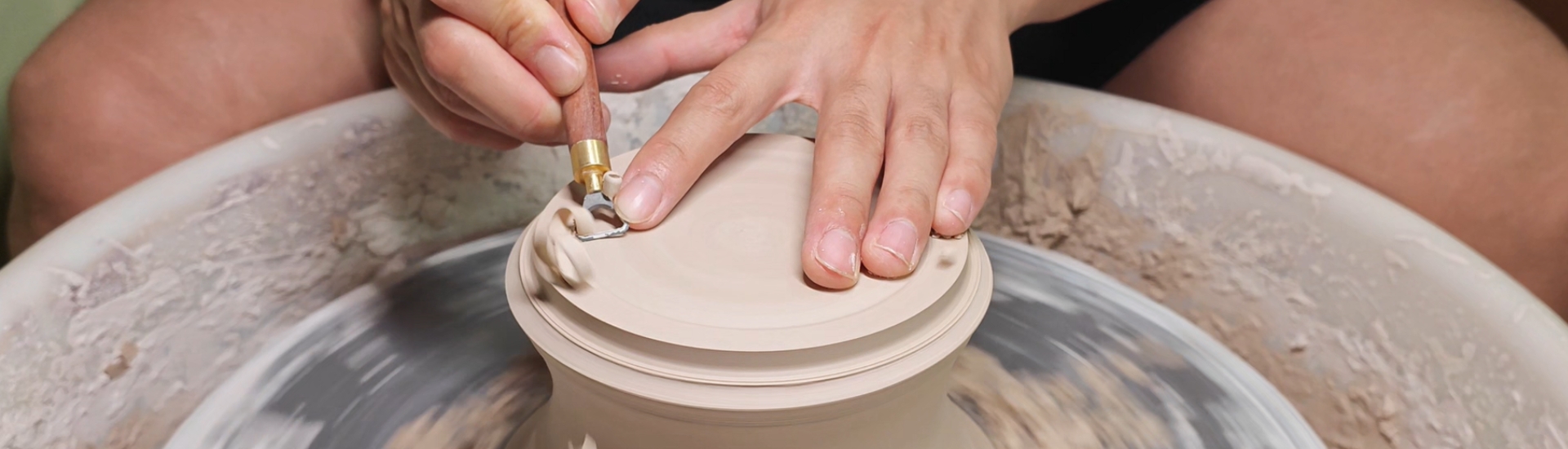
Tungsten carbide is widely valued in pottery trimming because it is hard, wear-resistant, and able to hold a useful cutting edge through repeated studio use.
That does not mean every carbide grade behaves the same way—or that hardness alone determines how durable a trimming tool will be.
For a pottery trimming tool, long service life depends on a combination of material grade, cutting-head geometry, clay condition, cutting load, and how the tool is handled during use.
Understanding these factors makes it easier to choose and use carbide tools correctly.
YG9, YG11 and YG15 Carbide Grades
KOVO Tools uses YG-series tungsten carbide grades including YG9, YG11 and YG15.
These grades are not simply “low, medium and high quality.” Each one represents a different balance between hardness and bending strength.
| Grade | Cobalt Content | Density | TRS | Hardness |
|---|---|---|---|---|
| YG9 | 9% | 14.6 g/cm³ | 2430 MPa | ≥89.5 HRA |
| YG11 | 11% | 14.3 g/cm³ | 2600 MPa | ≥88 HRA |
| YG15 | 15% | 14.1 g/cm³ | 2800 MPa | ≥87 HRA |
Source: KOVO Tools material specification data.
The pattern is easy to see:
- YG9 has the highest hardness of the three.
- YG11 moves toward a more balanced hardness and bending-strength profile.
- YG15 has the highest transverse rupture strength, with somewhat lower hardness.
This is an engineering trade-off rather than a simple ranking.
A harder grade can offer excellent wear resistance and edge retention, while a grade with greater bending strength may be preferred where the cutting-head geometry needs a larger strength margin.
Hardness and Strength Are Not the Same Thing
One of the most important things to understand about carbide is that hardness does not mean flexibility.
Hardness helps the cutting edge resist wear.
TRS, or transverse rupture strength, is a laboratory measure used to compare how carbide materials perform under bending.
Neither number tells you by itself exactly how much force a finished pottery trimming tool can withstand.
The actual tool is also affected by:
- Cutting-head thickness
- Cross-sectional area
- Loop or hook geometry
- Bend radius
- Connection points
- Direction of force
- Cutting depth
A thin hook and a broad loop made from the same carbide grade will not respond to bending in exactly the same way.
What Can Cause a Carbide Trimming Tool to Break?
Under normal trimming, the cutting edge is mainly removing clay in a controlled direction.
Breakage risk increases when the load changes from cutting to bending, twisting, impact, or repeated vibration.
1. Deep or aggressive cuts
Trying to remove too much clay in one pass increases the load on the cutting head.
If the edge suddenly catches, the force can become much greater than during a normal controlled cut.
Several lighter passes are usually safer and easier to control.
2. Sideways force and twisting
Carbide trimming heads are designed to cut along the edge.
Using a hook as a lever, twisting the tool while it is buried in the clay, or pushing strongly sideways changes the type of load acting on the carbide.
These loads are very different from normal trimming.
3. Clay that is too dry
Leather-hard clay should still cut without excessive force.
As clay becomes very dry, trimming resistance increases. The tool may scrape, chatter, or require much more pressure.
Forcing a deep cut into overly dry clay places more stress on both the cutting edge and the tool geometry.
4. Repeated chattering
Chattering is not only a surface-finish issue.
When the cutting edge repeatedly catches and releases, the load on the tool also changes rapidly.
If strong chattering continues, stop and check:
- Clay moisture
- Cutting pressure
- Tool angle
- Wheel speed
- Hand support
- Pot centering
Correcting the cause is better than pressing harder against the vibration.
5. Impact with hard surfaces
Tungsten carbide handles abrasive clay very well, but direct impact is a different type of stress.
Contact with a metal wheel head, hard bat, concrete floor, or another hard object can chip the edge or damage the cutting head.
A small impact does not always lead to an immediate fracture. Damage can become more significant after continued loading during later trimming sessions.
6. Tool geometry
Shape matters.
Longer, thinner, or more open carbide sections naturally experience different bending loads than short, heavier sections.
This is why carbide grade, cutting-head thickness, and tool geometry need to be considered together rather than looking only at the material name.
What About Grogged and Coarse Clay?
Grogged stoneware and coarse clay bodies are abrasive, which is one reason tungsten carbide is useful for pottery trimming.
Its wear resistance helps the cutting edge stay effective longer and reduces the need for frequent sharpening.
However, abrasion and mechanical overload are different things.
A carbide edge may resist abrasive wear very well while still being vulnerable to:
- Heavy side loading
- Sudden impact
- Deep forced cuts
- Strong twisting
- Severe repeated chattering
For coarse clay, let the edge cut gradually rather than forcing it through resistant areas.
How to Extend the Life of a Carbide Pottery Trimming Tool
For longer and more consistent tool life:
- Trim at a workable leather-hard stage.
- Use controlled, progressive passes.
- Let the cutting edge remove the clay instead of forcing the tool deeper.
- Keep your hands supported and the pot centered.
- Reduce pressure if chattering begins.
- Avoid twisting or prying with loop and hook heads.
- Keep carbide away from the wheel head and other hard surfaces.
- Store tools where the cutting heads cannot strike each other or fall onto the floor.
These habits also make trimming smoother and easier to control.
Why Different Carbide Grades Matter
The goal of choosing a carbide grade is not simply to use the hardest material available.
A good pottery trimming tool needs the right balance of:
hardness + wear resistance + bending strength + cutting geometry
YG9, YG11 and YG15 provide different balances within that range.
Combined with the right cutting-head design and appropriate trimming conditions, tungsten carbide can provide a long-lasting edge, fewer sharpening interruptions, and a more consistent trimming experience.
The key is to use carbide for what it does best:
clean, controlled cutting—not prying, twisting, or forcing the tool through the clay.